
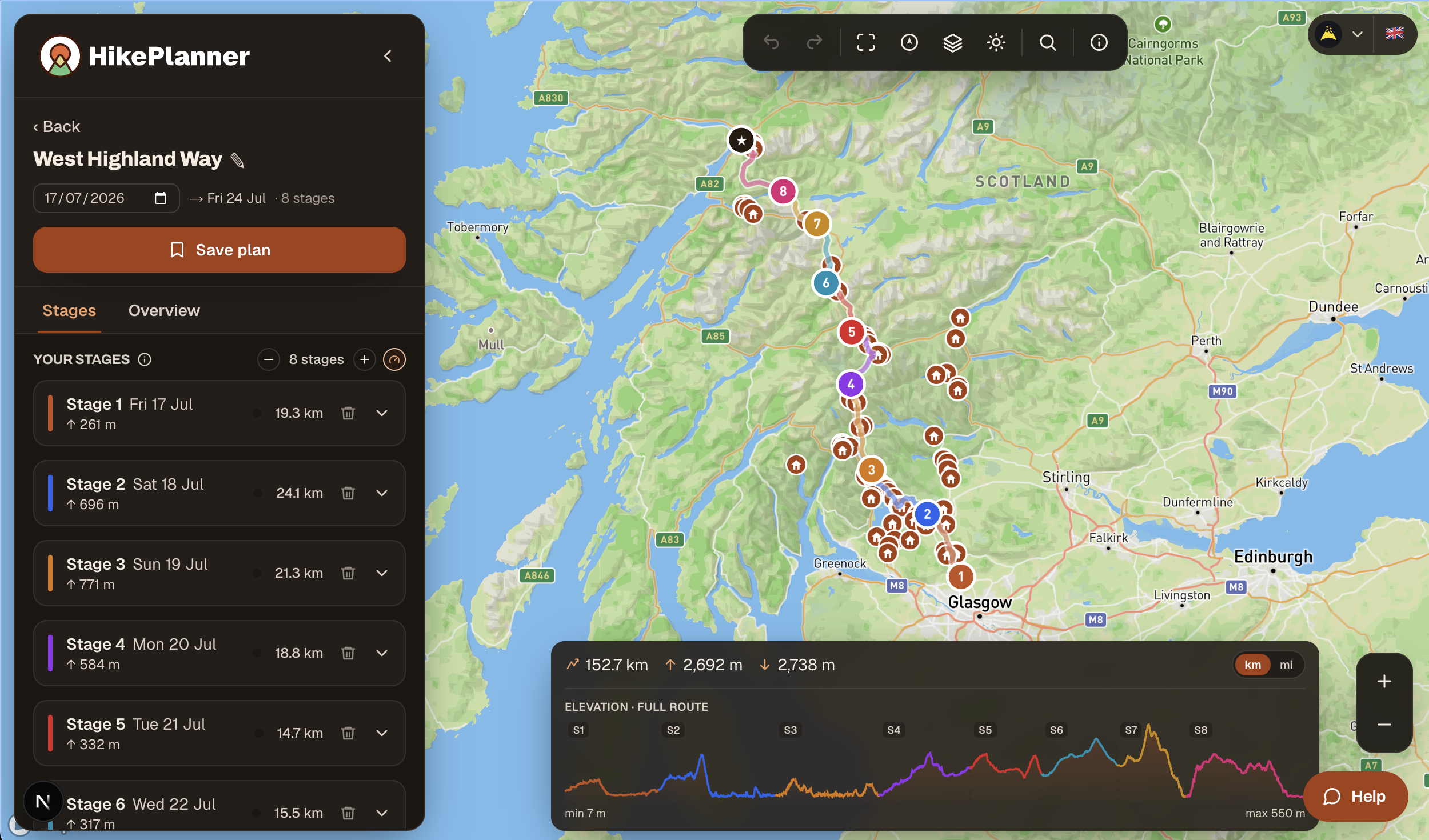
Anyone who has organised a multi-day walk knows the planning rarely happens on the trail. It happens at the kitchen table, weeks beforehand, surrounded by browser tabs, a half-finished spreadsheet, and a map app that was never built for thru-hiking. You’re trying to split a route into sensible days, work out where you’ll sleep each night, and keep three friends in the loop — all at once, and none of the tools talk to each other.
Hike Planner is a free web app built to fix exactly that. It takes a long-distance trail and lets you build the whole thing end to end: every stage, every climb, and a bed for every night, in one place. We spent some time with it, and it’s worth a look if you’ve got a big walk on the horizon.
What it actually does
The premise is simple. You pick a long-distance hike, and Hike Planner turns it into a stage-by-stage itinerary you can shape around your own trip. Rather than starting from a blank map, you start from a route that already exists and tweak the day splits, the pace and the overnight stops to suit you.
Three things make up the core of it:
Stage-by-stage routes. Each trail is broken into days with real distances, daily elevation and sensible splits — the kind of detail you’d otherwise piece together from a guidebook and a contour map. If a suggested day is too long, you adjust it.
A bed for every night. This is the part that usually eats the most planning time, and it’s where Hike Planner is most useful. Mountain huts, hostels, B&Bs and inns are plotted right where they sit along the route, so you can line up accommodation against your stages instead of cross-referencing a booking site with a map.
GPX export. Once your itinerary is built, you can export the lot to GPX and load it onto your watch, phone or GPS device. The plan you make at home is the plan you carry on the trail.
There’s also a group-sharing element — you can share the whole itinerary with the people you’re walking with, so everyone is working from the same plan rather than a screenshot in a group chat.
The trails it covers
Hike Planner isn’t limited to a handful of marquee routes. It covers thousands of multi-day trails, including most of the names you’d expect to find on a bucket list. A glance at its featured hikes turns up the Tour du Mont Blanc (around 165 km over roughly 11 days), the full Camino de Santiago Francés at over 860 km, California’s John Muir Trail, and the West Highland Way.
There’s plenty for long-haul ambitions too — the South West Coast Path runs to over 1,000 km and around 63 days if you walk the whole thing, while shorter trips like Germany’s Malerweg or Ireland’s Kerry Way fit into a week or two. Coastal paths, alpine passes, desert crossings — the range is wide enough that most people will find the walk they’re dreaming about already mapped.
Free, with a light touch on sign-ups
The thing that stands out is the pricing, which is to say there isn’t any. Hike Planner is free to use, and you only need to create an account if you want to save your plans. You can land on the site, pick a trail and start building an itinerary without handing over an email address first — a refreshingly low barrier for a tool that does this much.
That openness extends to how the platform grows. The accommodation map is partly community-driven: if you know a scenic campsite along a route or a cosy B&B that took good care of you, you can add it to the map for the next hiker coming through. It’s the kind of crowdsourcing that makes a planning tool genuinely better over time.
A nice touch: backing Mountain Rescue
One detail worth calling out. Hike Planner runs a giving-back scheme tied to the volunteer Mountain Rescue teams who look after the trails it helps you plan. Each quarter the team backs one rescue group, and says 100% of donations go straight to them. For a free tool, building support for the people who head out in any weather to help hikers in trouble is a thoughtful move — and a reminder that planning well is itself part of staying safe out there.
How does it differ to HiiKER?
It’s very much tailored to following famous routes and that alone while building an itinerary to use. You can of course do that with HiiKER, but this is more bespoke to the idea. Good news is that when you finish an itinerary you can send it directly to your HiiKER account to track and follow while actually on the route, with your accommodation choices listed as hike highlights!
Is it worth using?
If your hiking is mostly day walks, you probably don’t need it. But if you’re planning anything multi-day — a long-distance path, a hut-to-hut traverse, a pilgrimage route — Hike Planner solves a real and annoying problem. It pulls route planning, daily stages, elevation, accommodation and GPX export into a single workflow, and it does so without a paywall or a forced sign-up.
The best endorsement is the spreadsheet you won’t have to build. If you’ve got a big walk on the calendar, it’s worth half an hour of your evening to map it out properly. You can start planning at hike-planner.com.
Planning a multi-day route this season? Map your stages, find a bed for every night, and tell us how it goes.